
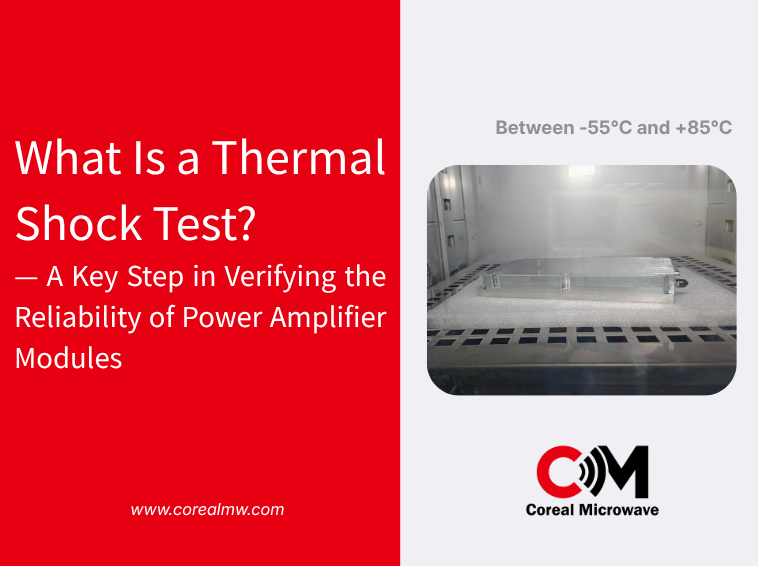
A power amplifier module may perform flawlessly, delivering 100W of output power at room temperature in a laboratory setting. But what happens if it is installed in an aircraft—rapidly climbing from a 40℃ tarmac on the ground to a cruising altitude of 10,000 meters where the temperature is -50℃, and then diving back to the ground? Can it continue to operate reliably after experiencing a temperature swing of nearly 100℃ in just a few tens of minutes?
This is the question that thermal shock testing is designed to answer.
The core principle of thermal shock testing lies in exploiting the mismatch in the coefficients of thermal expansion (CTE) among different materials.
A power amplifier module is composed of various materials: GaN or LDMOS semiconductor chips, solder layers, ceramic or metal substrates, packaging housings, gold-wire interconnects, and RF connectors. When the module undergoes a drastic temperature change over a very short period, these materials expand or contract at different rates. This differential deformation generates immense thermal stress at material interfaces and connection points; when this stress exceeds the material's structural limits, failures such as cracking, delamination, or solder joint fatigue can occur.
Key Parameters for Thermal Shock Testing
|
Parameter |
Typical Requirement |
|
Temperature Extremes |
e.g., -55℃ to +85℃ |
|
Transition Time |
Typically ≤ 1 minute |
|
Dwell Time |
30 minutes to several hours, ensuring the entire sample reaches thermal equilibrium |
|
Number of Cycles |
Ranging from a few to hundreds, depending on the specific application scenario |
|
Temperature Change Rate |
>10℃/min is classified as a thermal shock |
Within Coreal's reliability verification framework, thermal shock testing—alongside aging (burn-in) tests and vibration tests—forms an essential part of the environmental stress screening (ESS) process conducted before a product leaves the factory. For instance, the recently introduced C2080H50 (2–8 GHz, 100W) ultra-wideband power amplifier module underwent a rigorous thermal test: cycling between -55℃ and +85℃ for 5 complete cycles, with a 2-hour duration for each cycle. This temperature range encompasses the typically harsh environments encountered—from the low temperatures of high-altitude flight to the high-heat conditions within airborne or vehicle-mounted compartments. Through multi-cycle testing, we verify both the parameter stability and the structural integrity of our products when subjected to repeated thermal shocks.
More importantly, thermal shock testing is not an isolated procedure. It works in tandem with aging tests (24 hours for the first unit, 12 hours for subsequent units) to screen for early-stage failures, and with vibration testing (mandatory for the first unit) to validate mechanical integrity. Combined with built-in protections—against overcurrent, overvoltage, overtemperature, and high VSWR—these measures create a comprehensive reliability loop that spans from "verifying endurance" to "providing active protection during anomalies."
The true value of thermal shock testing lies not in the test itself, but in how it answers the question that matters most to our customers: "How long will this power amplifier last in my system?"
Coreal possesses the R&D and manufacturing capabilities for both modular and rack-mount power amplifiers, with a product portfolio spanning frequencies from 1.5 MHz to 50 GHz and output power levels ranging from tens of watts to several kilowatts. We invite you to visit our Product Center to review the reliability specifications and environmental adaptability parameters for our various amplifier series, or contact us directly to request sample thermal shock test reports and guidance on product selection.